- By Admin
- 16 Apr, 2026

SpaceUpp is a workplace governance advisory firm helping Indian organisations build systems that protect, stabilise, and strengthen the workplace.
SpaceUpp is a workplace governance advisory firm helping Indian organisations build systems that protect, stabilise, and strengthen the workplace.

Every organisation has policies. Most have a code of conduct, a grievance mechanism, an appraisal framework, and some version of a DEI commitment. These systems exist on paper and, in many cases, are reasonably well designed.
Yet in organisation after organisation, the same gap appears: the systems exist but do not function as intended.
The gap is rarely a policy problem. It is almost always a leadership problem.
Every governance system in an organisation is ultimately upheld — or undermined — by the people who lead within it. Leadership is the only form of governance that cannot be written into a document. And it is the one that determines whether the other systems work.
Consider what happens when governance systems meet leadership behaviour in practice.
A PoSH policy exists. But the manager discourages the team from "making things complicated." Complaints go unreported. The policy becomes decoration.
An appraisal framework exists. But the leader promotes the people they are closest to. The framework becomes a formality. High performers who lack proximity leave.
A DEI framework exists. But the leader sponsors people who remind them of themselves. Representation does not improve. The framework becomes a number on a slide.
A grievance mechanism exists. But employees do not trust the leader enough to use it. Problems compound in private until they become crises in public.
None of these are policy failures. The policies were in place. They are leadership failures — and they are far more common than most organisations acknowledge, because they rarely appear in audits or compliance reports. They appear in attrition data, complaint patterns, engagement scores, and the quiet exits of people who stopped believing the system would work for them.
Governance on paper and governance in practice are two different things. The distance between them is almost always measured in leadership behaviour.
When a harassment complaint is not taken seriously, the failure is not the PoSH policy. It is the leader who created an environment where reporting felt unsafe.
When a promotion process consistently produces homogeneous outcomes, the failure lies not in the appraisal framework. It is the leader whose unconscious preferences shape every decision within it.
When an organisation's DEI commitments remain aspirational year after year, the failure is not the strategy document. It is the leadership layer that was never developed to operationalise it.
This is the governance argument that most organisations miss: systems create the standard, but leaders determine whether it is kept. An organisation can have the most robust governance framework in its industry and still produce poor outcomes if the leadership layer is not equipped to uphold it.
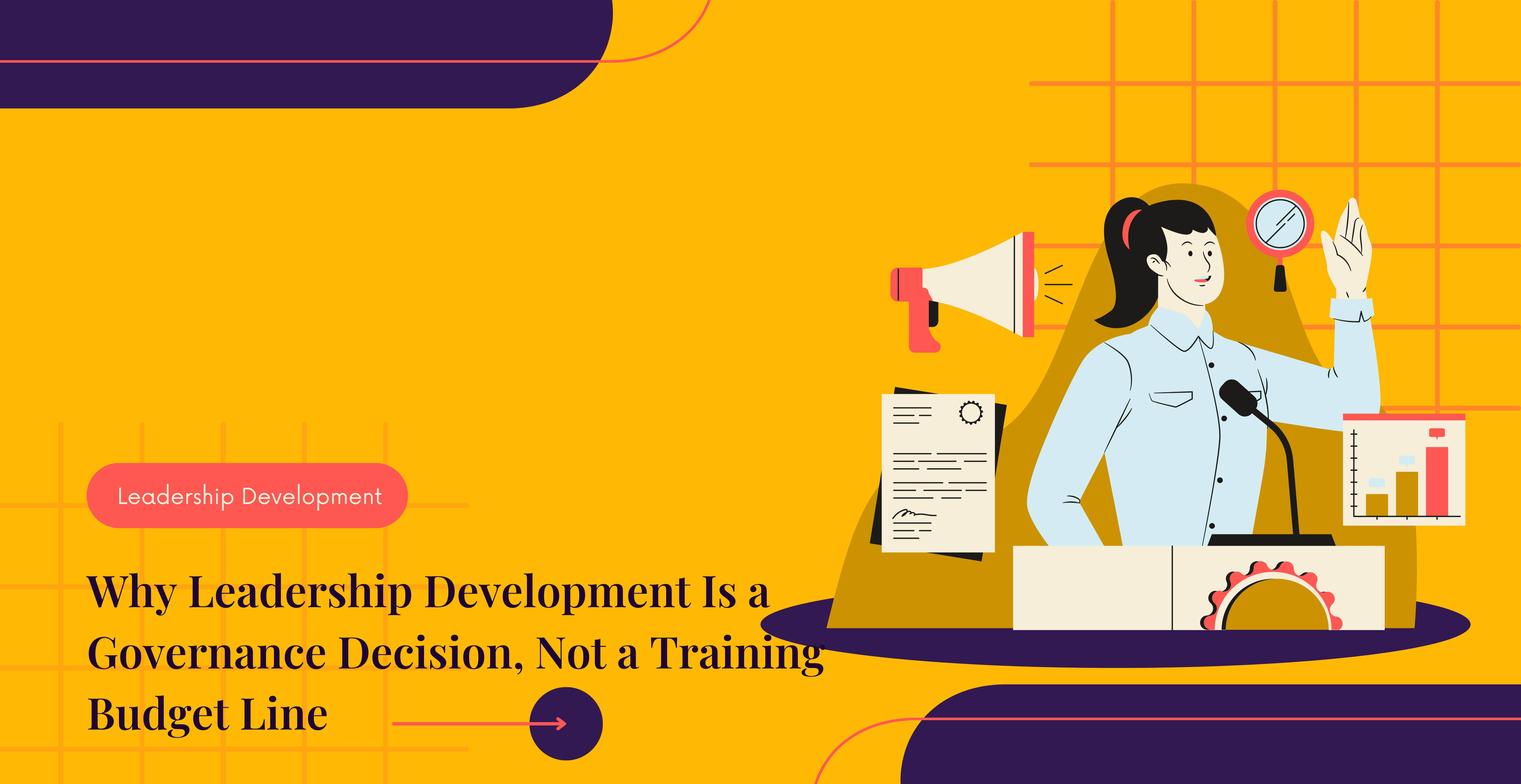
Leadership development is therefore not a training investment. It is a governance investment. It is the mechanism through which policies become practice.
The qualities that make a leader capable of upholding governance rather than inadvertently undermining it span three dimensions.
How a leader relates to people: Empathy, emotional intelligence, and inclusion. These determine whether employees feel safe speaking, whether concerns surface early or late, and whether the leader's decisions account for the full range of experiences on their team.
How a leader makes decisions: Equity, accountability, consistency, and decisiveness. These determine whether governance standards are applied uniformly or selectively, whether accountability reaches senior levels or stops below them, and whether decisions are made on merit or on proximity.
How a leader builds the environment: Transparency, psychological safety, and self-awareness. These determine whether the team operates in a climate of trust or one of management, and whether the leader can recognise and correct their own blind spots before they become systemic problems.
None of these is an innate trait. They are learnable competencies. They improve with structured development, honest feedback, and accountability frameworks that require leaders to examine and evolve their own behaviour.
The organisations that treat these qualities as developable — and build systems to develop them — consistently outperform those that treat them as personality.
The organisational outcomes of strong leadership are consistent across industries, geographies, and organisation sizes.
Psychological safety increases. People raise concerns early, share ideas openly, and flag problems before they compound. An organisation where employees feel safe to speak catches risk before it becomes liability.
Retention improves. According to SHRM, replacing an employee costs between 50% and 200% of annual salary. People leave managers more often than they leave organisations. When leadership is equitable and consistent, attrition decreases in direct proportion.
DEI outcomes shift. Representation at senior levels improves when leaders actively sponsor talent across gender, background, and function — not because targets demand it, but because equitable decision-making is how they operate.
Governance systems function as designed. Complaint mechanisms get used. Appraisal frameworks produce fair outcomes. Policies move from paper to practice.
A founder leading a team of ten carries the same governance responsibility as a divisional head in a company of a thousand. A team lead in a growing startup shapes the governance environment for their direct reports as much as a CXO shapes it for the organisation. The scale differs. The principles do not.
Leadership behaviour sets the standard for everyone below it, in every organisation, at every stage of growth. That standard either reinforces or erodes every other system the organisation has built.
The question is not whether leadership development matters at a given size. The question is whether the organisation is developing its leaders intentionally or leaving governance to chance.
Why is leadership development important for organisations? Leadership development builds the competencies that determine whether governance systems function in practice — accountability, equity, transparency, and psychological safety. Without developed leaders, even well-designed policies fail at the point of implementation.
How does leadership affect workplace governance? Leaders operationalise governance. Every system — complaint mechanisms, appraisal frameworks, DEI commitments, conduct standards — depends on leaders to uphold it consistently. Leadership behaviour is the difference between governance on paper and governance in practice.
What leadership skills improve organisational performance? The capabilities most directly linked to performance outcomes are accountability, equity in decision-making, psychological safety cultivation, emotional intelligence, transparency, and self-awareness. These are measurable, developable, and directly tied to retention, engagement, and governance outcomes.
How does leadership influence employee retention? People leave managers more often than they leave organisations. Leaders who operate with consistency, fairness, and psychological safety create environments where talent stays. Those who do not create environments where the cost of attrition compounds quietly until it becomes visible in exit data.
Build Leaders Who Are Equally Accountable to Their People and Their Business
SpaceUpp develops leaders who hold both responsibilities simultaneously — accountable to the people they lead and to the business they serve. Neither takes precedence. Both are built together.
That development happens in two ways.
Organisations can work with SpaceUpp to build leadership capability across teams and cohorts — structured programmes that develop the specific competencies leaders need, at the scale the organisation requires.
Individuals can also approach SpaceUpp directly. Leaders who want to build their own capability — independent of an organisational programme — can work with SpaceUpp to develop the skills, self-awareness, and accountability frameworks that make them more effective in any role, at any level, in organisations of any size.
Leadership capability determines whether accountability, inclusion, fairness, and performance systems function in practice.