- By Admin
- 09 Jul, 2026

SpaceUpp is a workplace governance advisory firm helping Indian organisations build systems that protect, stabilise, and strengthen the workplace.
SpaceUpp is a workplace governance advisory firm helping Indian organisations build systems that protect, stabilise, and strengthen the workplace.

Ten years ago, ESG was a framework that most Indian businesses treated as optional. A reporting exercise for multinationals. A compliance layer for listed companies. Something the West cared about more than we did.
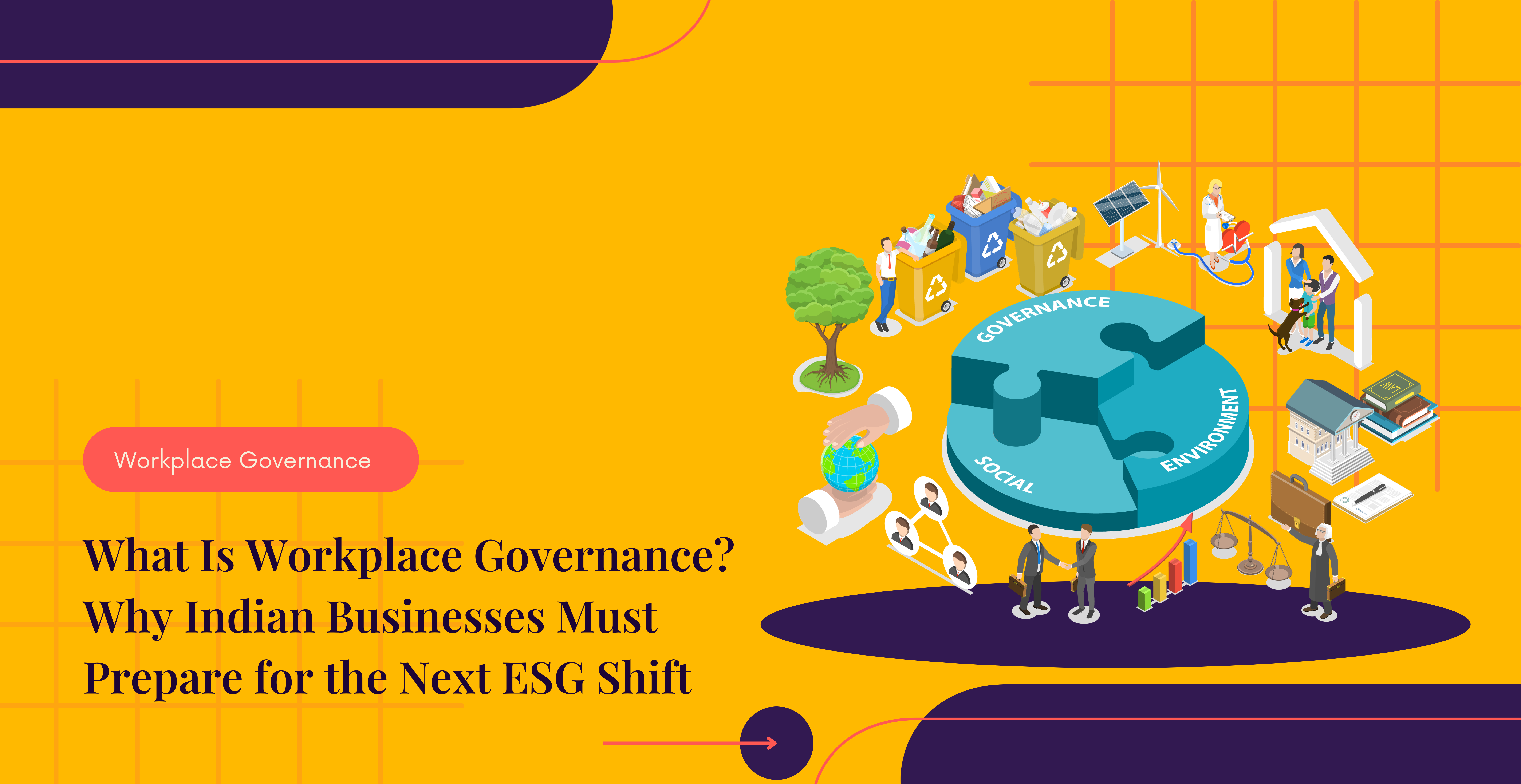
ESG stands for Environmental, Social, and Governance. It is a framework that measures how an organisation manages its environmental impact, how it treats its people and communities, and how its leadership makes decisions and is held accountable. Initially adopted by institutional investors to screen investments, ESG quickly moved from a reporting exercise to a business imperative. Today, ESG criteria determine whether institutional investors put money in, whether global clients sign contracts, and whether talent chooses one employer over another.
Organisations that moved early built an advantage. Organisations that waited spent years catching up publicly, expensively, and under pressure.
Workplace governance is at the same inflexion point ESG was a decade ago. The organisations paying attention now will define what it looks like for everyone else.
Governance gets borrowed freely and defined loosely. In the context of how organisations manage their people, it has a specific meaning.
Workplace governance is the full operating system of how an organisation makes decisions, enforces accountability, and manages its people across every function and level. It is not about one policy or one training session; it is the entire architecture of how an organisation actually runs, rather than how it intends to run.
That architecture spans more than most leaders realise.
It includes compliance and legal systems: whether the organisation meets its statutory obligations under PoSH, labour law, and equal opportunity frameworks.
It includes people safety: physical safety protocols, psychological safety, anti-harassment systems, and grievance mechanisms that function independently of who is involved.
It includes diversity and equity: whether hiring, promotion, pay, and access to opportunity are structured fairly or whether proximity to power determines outcomes.
It includes learning and development: who gets trained, who gets sponsored for growth, and whether L&D investment is distributed equitably or concentrated at the top.
It also includes how the organisation communicates: whether employees understand decisions that affect them, whether information flows equitably across levels, and whether leadership is transparent about direction and change.
It includes growth and performance systems: whether appraisal criteria are clear and consistently applied, whether promotion tracks are visible, and whether performance is measured fairly across gender, background, and function.
It includes culture and behaviour frameworks: code of conduct, allyship structures, bystander accountability, and how the organisation navigates the tension between uniformity and individuality.
And it includes leadership accountability: whether those at the top are held to the same standards as those they lead.
Governance is what remains when goodwill runs out. It is the structure that determines what an organisation actually does, as opposed to what it intends to do, when something goes wrong.
An organisation with strong workplace governance has systems across all of these dimensions that are documented, actively enforced, and regularly audited. An organisation without it has intentions.
ESG did not become mandatory because regulators forced it overnight. It became mandatory because the conditions around business changed: investor scrutiny deepened, talent expectations shifted, and public transparency increased. Organisations with frameworks responded. Organisations without them scrambled.
Workplace governance is following the same pattern. In India, the conditions shifted sharply in 2025.
Regulatory pressure moved from gradual to board-level.
Regulatory scrutiny around PoSH compliance has moved from a procedural requirement to a board-level governance issue.
While the Sexual Harassment of Women at Workplace (Prevention, Prohibition and Redressal) Act, 2013 (PoSH Act) has been in force for over a decade, enforcement gained significant momentum following the Supreme Court's judgment in Aureliano Fernandes v. State of Goa & Others (2023). The Court expressed concern over widespread gaps in PoSH implementation and directed governments, regulatory authorities, employers, and institutions to ensure proper constitution of Internal Committees (ICCs), effective awareness measures, and compliance with statutory obligations.
This regulatory focus intensified in 2025. On 30 May 2025, the Ministry of Corporate Affairs (MCA) notified the Companies (Accounts) Second Amendment Rules, 2025, which came into effect on 14 July 2025. The amendments require every company obligated to prepare a Board's Report under Section 134 of the Companies Act, 2013 to include disclosures relating to PoSH compliance in its annual reporting framework.
The Board's Report must now disclose:
• The number of sexual harassment complaints received during the financial year.
• The number of complaints disposed of during the year.
• The number of complaints pending for more than ninety days.
• Compliance with the requirements of the PoSH Act, wherever applicable.
Importantly, these disclosure requirements extend beyond listed companies and apply to all companies required to submit a Board's Report under Section 134, including private companies and many MSMEs.
Non-compliance now carries direct financial and governance consequences. Under Section 134 of the Companies Act, failure to comply with Board's Report requirements can attract penalties of up to ₹3,00,000 on the company and ₹50,000 on every defaulting officer. Separately, Section 26 of the PoSH Act provides penalties that may extend to ₹50,000 for certain violations, with enhanced consequences for repeated non-compliance, including potential suspension, withdrawal, or non-renewal of business licences or registrations as permitted under applicable law.
Investor scrutiny is expanding beyond financials.
PE (Private Equity) and VC (Venture Capital) funds conducting due diligence now include governance checks as standard. An absent DEI framework & PoSH system, a non-diverse leadership pipeline, an unresolved complaint on record are red flags that affect valuations and deal timelines. Organisations that arrive without documented governance systems are not asked to fix them later. They are flagged as governance risks, and that flag travels into term sheets and board discussions.
Talent is deciding differently.
Senior professionals are evaluating governance signals before joining. A clear complaint mechanism, an equitable promotion track, visible DEI commitments backed by data — these are no longer differentiators. They are baseline expectations. Organisations that cannot demonstrate these systems are not losing candidates to better-paying competitors. They are losing them to better-governed ones.
The organisations treating workplace governance as a future consideration are making the same calculation that organisations made about ESG in 2014. Most of them regret it now.
The most useful way to think about workplace governance is as infrastructure.
Roads are not built after traffic arrives. Drainage systems are not installed after flooding. Infrastructure exists before the demand becomes a crisis, because its absence during a crisis is catastrophic.
A grievance mechanism built after a complaint is filed cannot handle that complaint. A DEI framework introduced after a discrimination claim cannot demonstrate proactive commitment. A code of conduct drafted after a conduct failure cannot establish the standard that was missing.
Governance built under pressure costs significantly more in time, money, legal exposure, and credibility than governance built as a foundation.
The picture is uneven. Large companies have compliance frameworks, though governance audits consistently reveal the gap between having a policy and having a functioning system is wider than leadership expects.
Mid-sized and growth-stage organisations are the most exposed. Large enough for incidents to occur across safety, equity, and performance. Not yet structured enough to handle them.
Startups are beginning to feel investor pressure on this. But pressure-driven governance is reactive governance. It is more expensive, less credible, and less effective than governance built as a foundation from the start.
The question for any Indian business today is not whether workplace governance will matter to them. It is whether they will build it or be required to explain its absence.
Organisations serious about building governance as infrastructure start in the same place: an honest assessment of what exists versus what is required — across compliance, equity, safety, performance, and leadership accountability.
The gap between what most organisations believe their governance looks like and what it actually looks like is the starting point for every governance conversation worth having.
Start the Governance Conversation
SpaceUpp works with Indian organisations to design and implement workplace governance systems that span compliance, equity, safety, and leadership accountability — built to function before they are needed, not assembled after they are not.
The starting point is always a clear picture of where the organisation currently stands.
Workplace governance is becoming a boardroom responsibility. The first step is understanding where your organisation stands today across compliance, accountability, safety, and leadership systems.