- By Admin
- 09 Jan, 2026
SpaceUpp is a workplace governance advisory firm helping Indian organisations build systems that protect, stabilise, and strengthen the workplace.
SpaceUpp is a workplace governance advisory firm helping Indian organisations build systems that protect, stabilise, and strengthen the workplace.

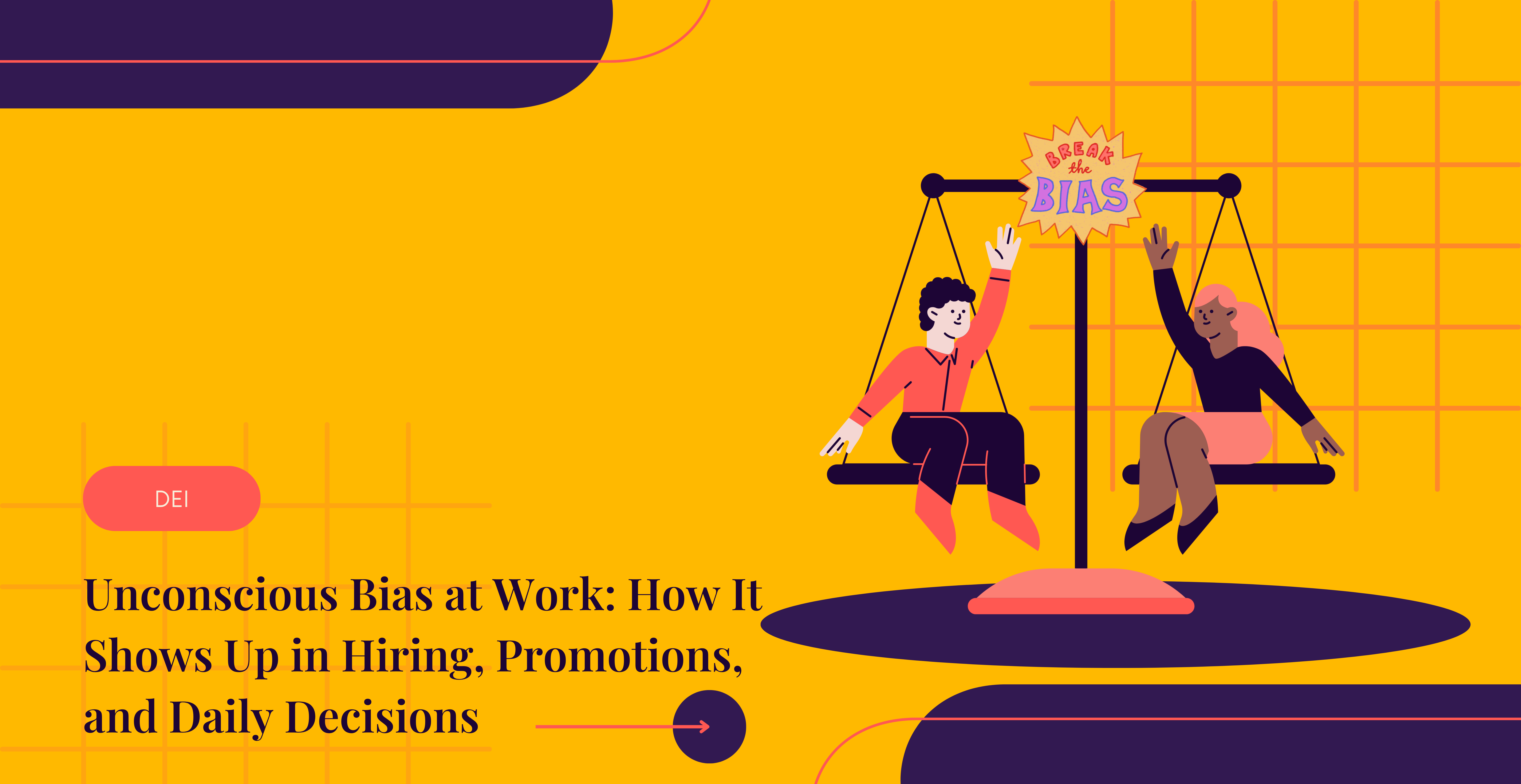
Unconscious bias does not feel like bias when it is happening.
That is the entire problem.
It feels like a gut instinct about a candidate. It feels like recognising someone's potential. It feels like a natural preference for a working style, a communication pattern, or a type of person who "fits" the team. It feels, in the moment, like good judgment.
The consequences, however, are the same as deliberate bias. The wrong people get hired. The right people leave. Opportunities concentrate in the hands of the few. And the organisation pays for it, in attrition, in performance, in legal exposure, and in the slow erosion of the leadership credibility that governance depends on.
Unconscious bias refers to the automatic associations, assumptions, and preferences that operate below conscious awareness and influence decisions without the decision-maker realising it.
These associations are not character flaws. They are the brain's shortcut system, like patterns built from experience, environment, and exposure, that allow rapid processing of large amounts of information. In many contexts, they are useful. In hiring, promotion, and management decisions, they are a governance liability.
The most consequential forms in Indian workplaces include:
Affinity bias — the tendency to favour people who are similar to the decision-maker in background, education, communication style, or personality. In practice, this means interview panels consistently advance candidates who went to the same institutions, speak the same way, or share the same socioeconomic background as the people evaluating them.
Halo and horn effects — where one strong positive attribute (a prestigious degree, a confident presentation, a recognisable employer name) causes the evaluator to overlook weaknesses, or one negative attribute causes them to discount genuine strengths. A candidate who interviews nervously but performs exceptionally loses to one who interviews confidently but performs adequately.
Attribution bias — where the same behaviour is interpreted differently depending on who exhibits it. A man who speaks assertively in a meeting is decisive. A woman who does the same is aggressive. A senior leader who misses a deadline had competing priorities. A junior employee who does the same lacks commitment.
Proximity bias — where visibility substitutes for performance. The person in the office, on the senior leader's calendar, or present at high-profile meetings gets the opportunity. The person doing excellent work quietly, remotely, or outside the leader's line of sight does not.
None of these feel like bias in the moment. All of them produce outcomes that a fair, evidence-based process would not.
In hiring, unconscious bias narrows the talent pool before the interview begins. Job descriptions written in language that signals a particular type of candidate, sourcing channels that reach only familiar networks, and interview panels that evaluate "culture fit" without defining what that means all filter out qualified candidates the organisation never sees.
The cost is not just fairness. It is a competitive disadvantage. Organisations that hire from a narrow pool consistently miss candidates who would have outperformed the ones they chose, and they never know it, because the counterfactual is invisible.
In promotions, bias compounds over time. When promotion decisions consistently favour certain profiles — educational backgrounds, communication styles, gender, or proximity to leadership — the organisation's senior levels become progressively less diverse. That homogeneity then reinforces itself: leaders hire and promote in their own image, the pattern deepens, and the organisation loses the varied perspectives that produce better decisions.
Research consistently shows that diverse leadership teams make better decisions under uncertainty. Organisations with homogeneous leadership teams are not just missing a representation target. They are operating with a structural disadvantage in their decision-making.
In daily decisions, bias shapes who speaks in meetings and whose contributions are heard, who gets assigned to high-visibility projects, whose mistakes are forgiven and whose reputation is defined, and who receives mentorship versus who receives management. These micro-decisions accumulate. Over months and years, they determine who stays, who grows, and who leaves — and the pattern of exits tells a story about the organisation that attrition data rarely captures fully.
Unconscious bias is not a single decision. It is the cumulative effect of thousands of small decisions, each one invisible in isolation and collectively determinative of who the organisation becomes.
Most organisations respond to unconscious bias with awareness training — a session that explains what bias is, names the types, and encourages participants to "check their assumptions."
Awareness is the necessary first step. It is not sufficient on its own.
Bias is a systemic problem. It operates through processes, not just through individuals. A hiring manager who has attended an unconscious bias session and returns to an unstructured interview process, a homogeneous panel, and a "culture fit" evaluation criterion will produce the same outcomes as before — with slightly more self-awareness about it.
What changes outcomes is structural intervention: structured interviews with consistent criteria, diverse panels, anonymised screening where appropriate, documented promotion criteria, and regular audits of decision outcomes across demographic lines. These are not HR reforms. They are governance reforms — changes to the systems through which consequential decisions are made.
The goal is not to eliminate bias from individuals. The goal is to design processes that produce fair outcomes regardless of whether individual bias is present.
An unconscious bias workshop that changes behaviour does three things that an awareness session does not.
It makes bias visible through real workplace scenarios — not abstract definitions, but situations that participants recognise from their own experience. Recognition is what creates the shift from "that happens elsewhere" to "that happens here."
It connects bias to business consequences — attrition, hiring quality, promotion patterns, team performance, and legal exposure. When leaders understand that bias costs the organisation measurably, not just morally, the conversation moves from values to governance.
And it introduces structural tools — specific changes to processes and decision frameworks that reduce the influence of bias on outcomes. Participants leave with practical interventions, not just heightened awareness.
Build the Structural Awareness That Changes Outcomes
SpaceUpp's unconscious bias workshops are designed for organisations that want more than a sensitisation session. The focus is on making bias visible, connecting it to business and governance consequences, and equipping teams with the structural tools to make fairer decisions — consistently, not just on the days after the training.